Thursday, May 23, 2013

Yep, our Branchial Cleft surgeon Dr. Green is pretty brilliant...

Scott Hollister, left, and Dr. Glenn Green of the University of Michigan
used plastic particles and a 3-D laser printer to create the first-ever airway splint
to save the life of a baby boy who used to stop breathing nearly every day. / AP
When he's not working on rare branchial cleft abnormalities, our surgeon Dr. Glenn Green of the University of Michigan is making pediatric ENT history!  Check out this MSNBC story on him and his team creating the first-ever 3-D laser printed implantable device, in order to save the life of a little guy with a constantly collapsing trachea.  Moral of the story?  Always find a world-class surgeon to open your baby's neck.  

If you loved your branchial cleft surgeon and think he or she is world-class, tell us!  Let's share our best branchial cleft surgeon recommendations from around the country in the comments to this post and make sure every parent can find a great surgeon in their region to consult with on this rare congenital disorder!

Wednesday, April 3, 2013

UPDATE: Two and Half years later...

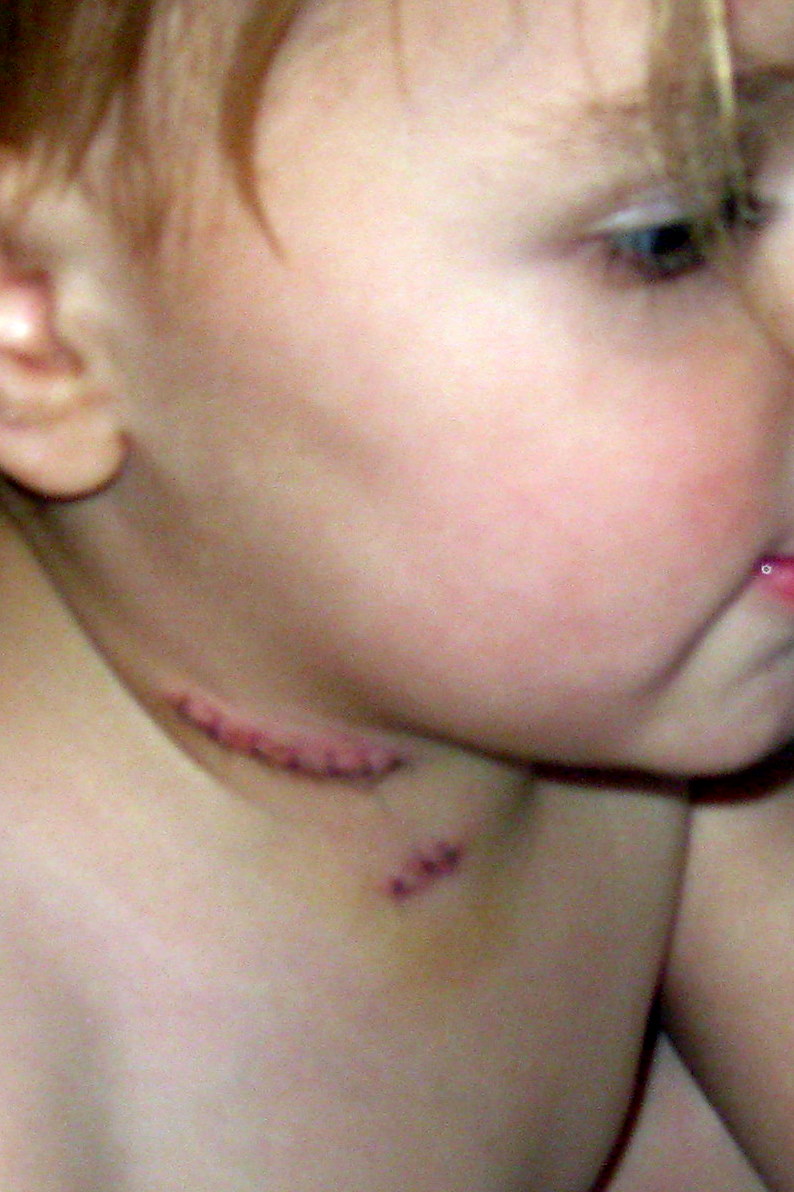
Hi readers! I have got a few comments recently and figured it might be time to post an update. I'm so thrilled you have found us (look, it's a community!) and hope our story (and others in the comments) might help you navigate your child's branchial cleft abnormality path a bit better. Here's a picture of our daughter 2.5 years after her surgery. We've had NO problems and her scars are very hard to notice (there's one horizonal one about 1 inch and a smaller one at the old opening site that's about a centimeter:
Can you see them?  Didn't think so...It's pretty hard to photograph well...
How about now?  That's the larger one in the middle of the photo and the small one is at the bottom.  I think she'll be good to go by Prom dress season!
 God bless all of you and please, continue to share your stories and let us know how your little one's journey turns out!

Tuesday, November 2, 2010

We're done!

Surgery is over!  It went well, although not as ideally as branchial cleft fistulas CAN go.  Dr. Green, from U-Michigan Pediatric ENT, conducted the surgery and she was in good hands.  Here's the basics:


Our daughter's branchial cleft abnormality was a fistula tract, with one opening at the base of her neck.  Dr. Green actually SHOWED us what he excised--the tract looked like a bloody red nightcrawler worm (I actually thought it would make good fishing bait!).  About the width of a pencil around and about 7 inches laid flat.  This was connected at the top of her neck to her tonsils, so they had to come out in order to get all the cyst/fistula material out.  If it's not all removed, it's possible it can regrow.  So our little 16 month old had her tonsils removed and two large incisions on her neck.  The one at the base of her neck was 4 stitches and the one further north was 9 stitches.  These are ugly, large visible scars and we hope they will fade with time.  But as a parent reading about this surgery beforehand, it's best to prepare yourself for the Frankenstein look on your child's neck.

Her recovery was okay.  The first night we spent in the hospital so she could be observed for infections or hemotomas, and hydrated intravenously.  She went home the next day with antibiotics and Tylenol 3 (with codeine).  She hated the T3 so we switched her to regular Tylenol on day 3 and she seemed unaffected.  The first night home we woke her up to get the T3 but after that we let her sleep and she did okay. 

We are going to get the stitches out in a few days and then plan to be DONE with this ordeal!  God bless anyone who has a little one with this condition and I hope you have learned from our story!

Thursday, May 27, 2010

Parental Googling--AKA, a doctor's worst nightmare

Yes, I've become "that mom"...a week has passed since we heard Kate would need open-neck surgery on her branchial cleft fistula.  Now that I have had some time to think about it, I'm flabbergasted the best treatment for this is a one-inch incision to remove a 2 cm tract.  Really?  I had to do some investigating.  I found two interesting studies, both by Texas doctors who had done a cauterization on the tract.  I'm not 100% sure either of these findings exactly parallel what Kate has, since the terminology starts to swim around on me a bit, but it seems at least worth investigating further:
AND:


So, I did what any slightly obsessive, over-protective mother would do--I contacted both these doctors and asked them more.  Dr. Green and U-M both have my fullest confidence, and if we need to do the full surgery, they're getting our business.  I just need to know I have exhausted every non-invasive, progressive option that exists and made sure it is not a fit for Kate's particular case.  Who knows, perhaps our family will pioneer the technique of cauterizing, not surgically excising, these branchial cleft abnormalities at University of Michigan hospital!!??!


Monday, May 24, 2010

Types of branchial cleft abnormalities

The Children's Hospital of Boston has an easy site on branchial cleft remnants.  There are four kinds of branchial cleft abnormalities, as described by the site:

  1. First branchial cleft anomalies are rare, but do occur as cysts that lie in front, behind, or below the earlobe or under the jaw. A first branchial sinus has an external opening below the jaw and above the hyoid bone (a bone present in the neck just above the voice box).
  2. Second branchial cleft sinuses occur as sinus tracts with an opening on the skin of the neck during the first 10 years of life, and as cysts during the second 10 years (see Figure 1). A skin tag or abnormal cartilage may occasionally be present at the opening of the sinus, and occasionally the tract may be felt as a band in the neck.
  3. Third branchial cleft sinuses are extremely rare and are often located near the thyroid and along the front part of the muscle in the neck which attaches to the collar bone.
     
  4. Fourth branchial cleft sinuses are also rare and are located low in the neck similar to the third cleft sinuses.
Dr. Green suspects Kate's is a second or third, likely second.  The ultrasound done on her at two weeks indicates it is suspected fourth, but Dr. Green is more experienced in branchial cleft abnormalities than the radiologists and doubts it is a fourth.  In fact, he said he had only seen one true fourth branchial cleft sinus in his lifetime and he said they are "a bear" to remove--they wrap down around the heart!  This would be a very grave prognosis and require (I am guessing) open chest cavity surgery.  We are prayerful it is not a fourth and perhaps even a very simple second that can be removed through the pin-hole opening only (no inch-long incision!). 

To determine where the tract goes, he will make a small cut on the opening and clamp the tract with a surgical clamp.  Then, he pulls!  He said you can see where the tract is by where it tugs on the skin.  This very low-tech method determines where and how he cuts next. 

Since we're discussing the rarity of the fourth type of branchial cleft abnormalities, it's worth discussing how rare the existence of any type at all is.  They do run in families (as ours does--my brother also has a long-closed mark on his neck!) but are only seen in a small percentage of children.  When she was diagnosed in the hospital at two weeks old, we had a contingent of medical students and residents tramp through wanting to examine our daughter's neck.  It seems that while branchial cleft abnormalities are something they all learn about, they rarely get to see one in person (lucky us!)  In fact, Dr. Green said he is referred cases from around the state of Michigan and the ENT department at U-M still only does about three or four branchial cleft cases a year!  Too bad we aren't as lucky in the lottery as we are in acquiring odd medical conditions...

A cyst is a cyst, until it's a fistula...

We met today with University of Michigan's Pediatric Ear, Nose and Throat specialist Dr. Glenn Green. He taught us that Kate's branchial cleft cyst is actually not a cyst but a fistula. Here's the difference:


  • cyst--an enclosed structure, with no openings

  • sinus--a structure with one opening, perhaps internally

  • fistula--a structure with two openings, one internally and one externally

So she has a
branchial cleft fistula, at least 2 cm. long internally from the ultrasound (they lost the tract on the ultrasound screen after that, so we really don't know how much longer, if any, it is) Dr. Green told us that the only treatment for a branchial cleft cyst (or fistula) is surgery, and unbelievably in this day and age, it still requires a GIANT neck incision. At least, this is what I heard. In reality, the incision will be about one inch (but that's giant on a baby girl's neck, don't you agree?) I was heartbroken about the severity of the surgery (1.5 hours long, general anesthesia, slicing my baby's NECK WIDE OPEN, risk of permanent nerve damage to the tongue and/or tonsil removal mid-procedure, overnight stay at Mott Children's Hospital, resulting inch-plus scar on my perfect child).

This was clearly MUCH more than I anticipated. I burst into fearful tears. All that for what appeared to be a pin-hold size opening on her neck? Was this worth it? Could we leave it? I likely had a
branchial cleft cyst (closed, but still...), I had made it 32 years without an incident. Dr. Green insisted that within 7-13 years the fistula would swell and then require multiple "ladder" incisions on neck skin that is much less pliable than hers is now. And of course, the danger of infections in the neck can't be understated. We will have to remove this soon.

This is where I must question modern medicine--you can laproscopically remove a woman's uterus but you can't remove a 2 cm. cyst in a baby's neck without an inch-long incision? It doesn't seem right. If anyone knows of a less-invasive procedure on a
branchial cleft cyst, please share!

We have scheduled Kate's surgery for September 2010. In the meantime, I will continue to learn as much as I can about
branchial cleft fistulas and hope that hers remains safe until then.